skip to main |
skip to sidebar
LIFEʻS PURPOSE BECOMES CLEAR IN HAWAI`I
Huffington Post - January 28, 2014 - By Catherine Bauknight
Most of us have that one question that comes up at some point, "What is my purpose in life?" Many who know that answer work tirelessly to accomplish goals needed to make a difference in that arena.
`Ehu Kekahu Cardwell is one of those fortunate people who knows his life's work. He believes answers to unsolved problems in the world lie with indigenous cultures, and specifically Hawai`i's culture and people.
He's been consistent in his connection with the Hawaiian culture and their plight to regain land and sovereign rights since he was a kid, he says.
"The Hawaiian culture is based on ancient knowledge connecting people and all living things", Cardwell reveals. He says the Hawaiian culture has long ago confronted modern day problems, having solved them thousands of years ago.
He continues, "The planet can become reconnected again with the understanding that the fundamental core is connection to the land."
Cardwell's work is not for monetary gain, fame or even recognition, but according to him it is a calling for his purpose in life.
As a former radio announcer for ABC, radio programmer and Top 40 radio host in such markets as San Francisco, San Diego and Honolulu, he now uses his talents to showcase people in Hawai`i who are making a difference.
He is co-host of "Voices Of Truth -- One-On-One With Hawai`i's Future," an award-winning weekly half hour television show that airs throughout Hawai`i, as well as about seventy cities throughout the world, and also online.
The show's purpose is to inspire armchair viewers to become active participants in creating a better future for Hawai`i or wherever they live.
"Voices of Truth" is produced by the Kaua`i-based Koani Foundation, an educational organization.
`Ehu Kekahu Cardwell shares with us in a Q&A his purpose that he has dedicated his life to and his connection to the people and culture of Hawai`i.
Q. How did you get involved with the culture of Hawai`i?
A. I knew by the age of twelve or thirteen that I would become involved with the people of Hawai`i, their culture and in the Free Hawai`i movement. Keep in mind we're talking about the 1960's so this movement didn't even exist back then.
One summer my parents decided our family would go to Hawai`i for a vacation. When we arrived and I stepped off the plane for the first time I was amazed -- everything sang to me. The air, the dirt, the flowers, the animals, the ocean and of course the people. It was like nothing I had ever experienced before. It felt to me as though I had just arrived home.
For most visitors Hawai`i means Waikiki, a playground you visit for a couple of weeks a year to vacation. For me Waikiki was a place to get out of so I could meet Kanaka Maoli -- ethnic Hawaiians -- the real people of Hawai`i.
I well remember during that first vacation announcing to my parents that "Hawai`i should not be part of America." As I said those words aloud, I remember having the thought, "Where is this voice coming from?" My parents who were politically conservative admonished me to never utter that again. So I would walk about in Waikiki trying to find Hawaiians to say it to.
I remember finally walking into Duke's one afternoon as an adult Hawaiian trio was rehearsing their show for the evening and as I approached them they stopped playing. They were like "Who is this white kid and what is he doing in here?" I said those same words to them that I had spoken to my parents. Immediately there was this stunned silence and their mouths dropped open. Then one of them kind of looked around, approached me, grabbed my hand and wouldn't stop shaking it and thanked me for what I had said. I remember standing there trembling as I fought back tears.
When I was fifteen one night I had a very vivid dream. In my dream I was standing on the sidewalk outside of the White House in Washington, D.C. with a group of Hawaiians and we were protesting something, but in the dream I did not know what it was.
Many years later in 1997 in southern California I bumped into a Hawaiian lady who was carrying a stack of brochures under her arm. I instinctively reached out to take one. I looked down at it and on the cover it said "Aloha March To Washington, D.C." and had an illustration of a Hawaiian standing in front of the White House. I immediately remembered my dream and just stood there and read the booklet from cover to cover about three times.
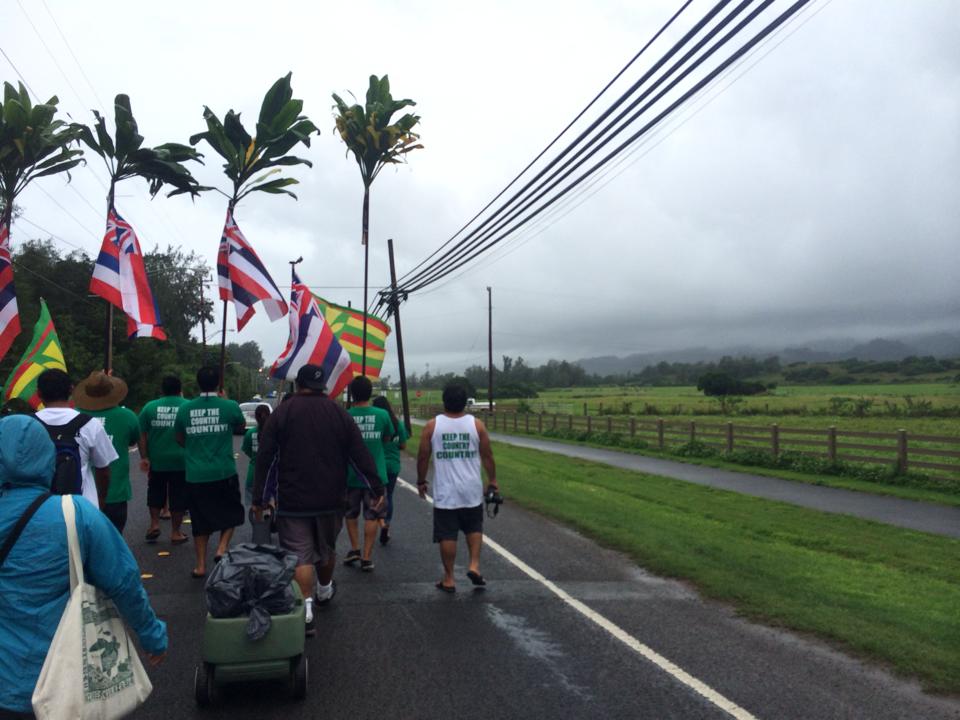
The brochure had been printed up by a full-blooded Kanaka Maoli from Anahola, Kaua`i named John Butch Kekahu. A few years back he had started the Koani Foundation and his mission and dream was to march down Pennsylvania Ave. from the U.S. Capitol to the White House to publicize the plight of Hawaiians.
After reading his brochure, I called him, introduced myself and asked if he had anyone handling the media and public relations for his march. He said no, that in fact he had been looking for someone. I gave him a brief overview of my expertise and background. During that phone call we agreed that I would fly over and meet face to face with him and his family. After doing so the following month, they invited me to be the media representative for the Aloha March which in fact occurred in August of 1998 and garnered extensive U.S. national and international media attention and coverage. A second Aloha March happened in 2000.
Shortly before Butch Kekahu's passing in 2001 he tasked me, as well as a small group of others to carry forward the mission and work of the Koani Foundation which of course is the realization of a free and independent Hawai`i.
Q. How many years have you been involved in the Free Hawai`i movement?
A. I have been actively involved in the Free Hawai`i movement for twenty years.
Q. What is your background and how do you use your talents to represent the issues of Kanaka Maoli?
A. I was in radio and TV broadcasting for over twenty years, both in Hawai`i and the U.S. I know how to get to the core of an idea and tell a story simply, quickly and plainly and in a way that others find interesting and compelling. I know how to help others do that too. I know that media, and how to use it effectively, is one of the most powerful tools we have to achieve a Free Hawai`i.
Q. What is the core concern that you have for Kanaka Maoli?
A. The Kanaka Maoli culture is a complex and deeply developed culture going back thousands of years. Living on small islands in the middle of the Pacific, over many generations they successfully solved and implemented solutions to problems that today's "modern society" consider unsolvable.
The Hawaiian culture has had for centuries the answers to the problems that ails our planet today such as sustainability, global warming and other issues that especially plague so-called "developed western cultures." My concern/mission is to make sure the rest of the world learns that. When Kanaka Maoli are once again allowed to flourish on their own land without outside foreign interference and dominance through a prolonged illegal occupation by the United States, Hawaiians will flourish and as a result the rest of the planet will benefit too.
Hawai`i can once again be that shining beacon in the sea that sets the example for the rest of the world as to how to live in harmony with each other and Mother Nature. The Kanaka Maoli did it for thousands of years before westerners arrived, and they can do it again in a Free Hawai`i. When Hawai`i wins, the whole world wins.
Q. What happened to them as a sustainable people that brought them to near extinction?
A. When Captain James Cook and his crew first arrived in Hawai`i in 1778, they brought with them western diseases such as small pox, measles and syphilis for which Kanaka Maoli had no immunity. Consequently at that point the first genocide of Hawaiians occurred. When Cook first landed in Hawai`i there were about one million Kanaka Maoli or as many people living in Hawai`i as there are today. Due to the introduction of those western diseases, by the mid 1800's, some sixty years later, the Hawaiian population had been reduced to a mere 40,000.
Q. What is it that the Kanaka Maoli want to see happen to them and Hawai`i?
A. Some people are still surprised that the Free Hawai`i movement exists since we were taught in school that Hawai`i is the 50th state and that Hawaiians overwhelming wanted to become Americans.
Yet there never was a treaty of annexation making Hawai`i part of the U.S. Moreover, in the late 1800's a petition was delivered to the U.S. congress signed by the vast majority of Hawaiians alive at the time protesting annexing Hawai`i to the U.S. And most Hawaiians boycotted the 1959 statehood vote. Those that actually did vote were not Hawaiians at all but U.S. transplants that had moved to Hawai`i, and even the U.S. military stationed there.
What I want to see happen within my own lifetime is that they get their land back, their country back and their freedom back so they can make their own decisions about their future and for future generations to come. Hawaiians want to live in their own country once again -- The Hawaiian Kingdom -- as Hawaiian Nationals. They really don't see Hawai`i as part of the United States. They never have.
Q. Do you believe they can become sustainable again? If so, what needs to happen, in your opinion?
A. Of course they can become sustainable again. What needs to happen is for the U.S. to de-occupy Hawai`i. Once that "800 lb. gorilla" is removed, Kanaka Maoli will automatically move towards sustainability. Like all indigenous people, it's in their DNA.
Q. Is there anything the public can do to help Kanaka Maoli regain sustainability economically, socially and politically?
A. The public can and should educate themselves to the facts regarding the overthrow and the prolonged illegal U.S. occupation of Hawai`i and share that information with everyone they know.
Q. What is the source of your continued work and support, without becoming discouraged, in the movement for Kanaka Maoli sovereign rights?
What keeps me going is twofold -- one, knowing that this is a marathon rather than a sprint, and most importantly, that this is the work I came to do in this lifetime.
Q. Are there books, websites, specific programs you have done that you can refer readers to so they may become more informed?
A. VoicesOfTruthTV.com, FreeHawaii.Info, HawaiiFakeState.com and FreeHawaiiTV.com.
FOR HAWAIIANS CONNECTION TO THE LAND IS EVERYTHING
Huffington Post - November 13, 2013 - By Catherine Bauknight
In the voice of the Native Hawaiians, one of the basic sovereign rights is to connect with and honor the 'aina, the land. They continue to raise awareness of this right as sovereign people of the land, the Kanaka Maoli. Their compassion to live in connection with and honor the land is raising awareness of the culture and knowledge they have to create a sustainable future.
Ask yourself these questions: Do you want clean air and water, land and marine life, nontoxic food to remain a part of the Hawaiian community? Listen to discussions of sovereign rights that the Native Hawaiians are having. It is not only to prevent their own culture from becoming extinct but to secure Hawaii nei from over-development and destruction of its natural resources. "What happens to the land happens to the people", is common knowledge in the Hawaiian culture. The Kanaka Maoli continue to respect this knowledge handed down to them by their ancestors.
Hawaiians have been a thriving sovereign community for centuries in connection with the land. They used the water systems of natural flow from north to south reaching structured fish ponds and the ocean. The land in the flow of the water, designated and patented to the Kanaka Maoli was cultivated by them to grow taro, sweet potato, and other nutritious foods, creating a balanced diet. Medicinal herbs grew and were used to prevent and cure illnesses. They did not fish out of season.
With a sense of community care for the ohana, (family, community), sustainability was a natural way of living in synchronicity and connection with the land.
After the overthrow of the Hawaiian Kingdom in 1893, the self-proclaimed government was based on power and monetary gain. Commercialized sugar cane and pineapple plantations changed the social, cultural, and economic sustainability for the Native Hawaiian community. The priority of economic gain for the system in power was structured such that the lifestyle of the Native Hawaiian People's access, stewardship, and connection with the land became stifled.
Much of the land was claimed by the plantation owners, the water was diverted to their crops, royal patents were no longer considered legal by the new government, and the separation of the Hawaiians from the land continues to today. The basic need to reconnect to the land is one of the sovereign rights that the Native Hawaiians are discussing to reach a sustainable future for Hawaii.
Crown lands set aside for the Native Hawaiians have been considered "ceded lands" to the State of Hawaii. The connection to the land has also been disrupted by the dismantling of and development on sacred heiaus, and burial grounds. Typically, Hawaiians spend their time working as many as two-four jobs and still find themselves houseless, living on the beach or in a park. Inflation of the economy is caused in part by rich developments which increase the value of the land, and the importing of food and living supplies to the islands.
Becoming sustainable on the islands once again, since the overthrow of the Hawaiian Kingdom, through the lifestyle of connecting with the land, is the message, the movement, that the Native Hawaiians are sharing. They are pursuing their rights in courts of law, City Council meetings, and with developers who claim the land and prevent access to ancient areas of spiritual connection, to the ocean, water, and land, in some cases that was patented to their ancestors. Legal consideration of their land patents, respect for their culture, and an awareness of social, economic, and environment sustainability is a part of what the Native Hawaiians believe are their sovereign rights.
Reverting back to a sustainable existence connected through the natural resources of Hawaii, caring for each other as a community, and stewarding the land may seem superficial, but with the issues the world faces of global warming, polluted water, decimation of the land, oceans, and marine life, and starvation throughout our planet, considering the ancient knowledge of the Native Hawaiians that was once a sustainable and sovereign people, is a voice of reason to consider in political, social, and economic arenas for the future change for Hawaii and the global community. This is a part of Hawaiian sovereignty.