Showing posts with label Timoteo Haalilio. Show all posts

Saturday, May 09, 2026

HOT MAKES HISTORY WITH “KAMALEHUA” AT THE CONCERT HALL


Review Of "Kamalehua - The Sheltering Tree" By John Berger

Hawai‘i Opera Theatre General Director & CEO Andrew Morgan, left, and kumu hula Patrick Ke‘anini‘ulaookalani Makuakāne, welcomed the opening night audience to the official world premiere performance of “Kamalehua: The Sheltering Tree,” the world’s first full-length professionally staged and professionally produced Hawaiian-language opera, May 1, in the Blaisdell Concert Hall. Makuakāne is the director and the choreographer — he can also be spotted in several of the crowd scenes.

The opera celebrates the life of Hawaiian diplomat Timoteo Kamalehua Ha‘alilio a long-forgotten hero in Hawaii’s history, whose diplomatic mission to the United States, Great Britain, Belgium, and France, in the early 1840s, resulted in the international recognition of Hawaii as a modern independent and sovereign nation, and also in the British government’s repudiation of the criminal overthrow of the Hawaiian government by a British naval captain in 1843.

Internationally acclaimed Hawaiian baritone Quinn Kamakanalani Kelsey gives a superb performance – many may well say “a career best performance” – as Ha‘alilio. Kelsey commends attention with the power and richness of his voice. Kelsey conveys the turbulent emotions Ha‘alilio experiences with equal skill.

Kelsey has two powerful male co-stars. One is Brandon Boyle as Kauikeaouli, better known 180 years later as Kamehameha III, who selects his life-long friend for secret mission essential to the survival of Hawaii as a free nation, and then steers the kingdom through the time of the greatest peril it would face until 1887. I wish Kauikeaouli could see how Boyle is portraying him 180 years later.

Kelsey’s other powerful male co-star is Joshua Jeremiah as William Richards aka Rikeke. Richards came to Hawaii as a missionary but left missionary service and became a loyal and trusted member of the Hawaiian government. Kauikeaouli selects Richard to accompany Ha‘alilio – the result is several memorable duets by Jeremiah and Kelsey as the story takes Ha‘alilio and Rikeke half-way around the world.

Kelsey has a phenomenal leading lady in Hawaiian soprano Tasha Hokuao Koontz playing his wife, Hana Hooper Ha‘alilio, It should not be seen as taking anything away everything that comes before to give credit where it’s due and say – spoiler alert! – the first notes of Koontz’ s first aria are an “Oh wow! Jump start my heart!” moment. Koontz replicates that experience with each of her arias that follow.

Hawaiian Mezzo-soprano Blythe Iakuinipuaʻokahana Kelsey (Quinn's sister) is a commanding presence as Kekauluohi, the Kuhina Nui, a political equivalent to the haole (non-Hawaiian) office of prime minister or regent. Kelsey has several excellent scenes with Boyle, and a fine comic moment with another actor was well.

Librettist Victoria Nalani Kneubuhl may have taken liberties with history – I wasn’t there in 1843 – but John Pickle is delightful throughout as one of the story’s designated villains, Alexander Simpson, attaché to the British consul in Hawaii,  who persistently attempts to seduce Hana during her husband’s lengthy absence. Is Simpson sincere in his sentiments or only looking for a bit of spare? A single comment by a third character suggests it’s the latter, but whatever Simpson’s intentions in his heart-of-hearts may be, Koontz and Pickle have several great scenes together.

One of the most powerful dramatic moments in the show comes after – spoiler alert! – Admiral Thomas, for whom Thomas Square, on the mauka side of King Street across from the concert hall, is named, has arrived in Honolulu and put things right, and Kauikeaouli leads the people of Hawaii in chanting "Ua Mau ke Ea o ka ʻĀina i ka Pono!”

Many in the opening night audience joined in, and everyone applauded their approval when he finished.

Another dramatic highlight comes when six members of Makuakāne’s Hālau Hula Nā Lei Hulu i ka Wēkiu lead the entire cast in a dramatic defiant hula.

And there’s more! Credit for the artistic and cultural success of this magnificent milestone also goes to Leslie Goldman (Clarissa Lyman Richards), Adam Flower (Hawaii loyalist James Fowle Baldwin Marshall), Dr. David Young (United States Secretary of State Daniel Webster), Kawaiola Niukukahi-Holi Murray (“a retainer”), and Kip Wilborn, who makes a welcome return to the local stage playing both of the story’s villains – British Consul Richard Charlton and Capt. Lord George Paulet.

Credit also to Principal Guest Conductor Lance Inouye, the Hawai‘i Opera Theatre Scenic Department for its superb series of sets, to Props Manager Gen Boyer, and to Cheryl Flaharty (Costume Design) and Sarah Hodges (Dancer) for the angel that figures prominently in one scene….

….“Kamalehua: The Sheltering Tree” is a first-time milestone in the history of Hawaiian culture, of Hawaiian language and of Hawaiian music that should not be missed.

Thursday, May 07, 2026

KAMALEHUA - THE SHELTERING TREE


Kamalehua - The Sheltering Tree - Hawaiian Opera Sung In `Ōlelo Hawai`i Telling The Story Of The Great Kanaka Maoli Patriot Timoteo Ha`alilio

Photos - Tasha Hokuao Koontz


Tuesday, April 07, 2026

 KAMALEHUA: THE SHELTERING TREE


World Premiere Opera | Patrick Makuakāne, Director and Choreographer

The true story of Timoteo Ha`alilio, Royal Secretary and lifelong friend to King Kamehameha III.

Set in the mid-nineteenth century, the opera reveals the little-known history of the Hawaiian Kingdom and its early struggles to maintain independence. 

The focus is Ha`alilio’s 1842-45 mission to the United States, Great Britain, Belgium, and France to secure treaties recognizing Hawai`i as a sovereign nation with the goal of protecting the kingdom from annexation by foreigners.

Performance Dates -
Fri, May 1, 2026 @ 7:30pm
Sun, May 3, 2026 @ 4pm
Tues,May  5, 2026 @ 7:30pm
 
 
Tickets -
Available now: $40 – $145 https://tickets.hawaiiopera.org/events
 

Wednesday, December 03, 2025

A SAD ENDING FOR A HAWAIIAN PATRIOT


Achieving recognition of the Kingdom Of Hawai`i by the United Kingdom and the Kingdom of France as an independent country was a tremendous achievement by the team led by Timoteo Ha`alilio. 

After gaining recognition of Hawaiian independence, Ha`alilio and William Richards headed home. But sadly, when their ship finally arrived in Honolulu on 23 March 1845 only Richards disembarked to carry sad news to Kamehameha III, Kauikeaouli.

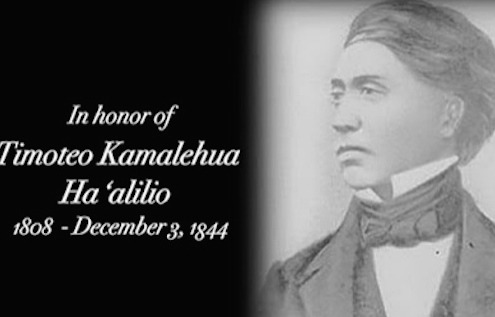
Timoteo Haʻalilio the close friend and confidante of the King, the one most trusted by the King, and the one who served his country with great honor had died at sea on his way home on the 3rd of December 1844. He was 36 years of age. 

All Hawai`i wailed and mourned for the loss of this great champion of their Kingdom. 

Today we honor Timoteo Ha`alilio for his service, his grace, his humility and his ultimate sacrifice in securing the recognition of the Kingdom Of Hawai`i as a sovereign, independent country.

Tuesday, December 03, 2024

A SAD ENDING


Achieving recognition of the Hawaiian Kingdom by the United Kingdom and the Kingdom of France as an independent country was a tremendous achievement by the team led by Timoteo Ha`alilio. 

After gaining recognition of Hawaiian independence, Ha`alilio and William Richards headed home. But sadly, when their ship finally arrived in Honolulu on 23 March 1845 only Richards disembarked to carry sad news to Kamehameha III, Kauikeaouli.

Timoteo Haʻalilio the close friend and confidante of the King, the one most trusted by the King, and the one who served his country with great honor had died at sea on his way home on the 3rd of December 1844. He was 36 years of age. 

All Hawai`i wailed and mourned for the loss of this great champion of their Kingdom. 

Today we honor Timoteo Ha`alilio for his service, his grace, his humility and his ultimate sacrifice in securing the recognition of the Hawaiian Kingdom as a sovereign, independent country.

Friday, December 03, 2021

TIMOTEO HA`ALILIO - HAWAIIAN KINGDOM PATRIOT

image

Because of the brave and tireless work of Hawaiian Kingdom statesman Timoteo Ha`lilo, on November 28, 1843 France and Great Britain formally recognized the Sandwich Islands (the Hawaiian Kingdom) as a sovereign, independent nation-state.

After this great victory for his country and on the way back home by ship Timothy Haʻalilio died at sea on this day, December 3 in 1844 from tuberculosis. He was only 36 years old.

Wednesday, November 24, 2021

FREE HAWAI`I TV
THE FREE HAWAI`I BROADCASTING NETWORK


"WHOʻS TIMOTEO HA`ALILIO? & WHY SHOULD YOU CARE?"


Donʻt Know Who Timoteo Ha`alilio was?

How About William Richards?

Would You Believe Two Important Hawaiian Kingdom Patriots?

Watch This To Discover What They Did That Changed History.

Then Share This Video Today With Your Family & Everyone You Know.


Thursday, December 03, 2020

A SAD ENDING


Achieving recognition of the Hawaiian Kingdom by the United Kingdom and the Kingdom of France as an independent country was a tremendous achievement by the team led by Timoteo Ha`alilio. 

After gaining recognition of Hawaiian independence, Ha`alilio and William Richards headed home. But sadly, when their ship finally arrived in Honolulu on 23 March 1845 only Richards disembarked to carry sad news to Kamehameha III, Kauikeaouli.

Timoteo Haʻalilio the close friend and confidante of the King, the one most trusted by the King, and the one who served his country with great honor had died at sea on his way home on the 3rd of December 1844. He was 36 years of age. 

All Hawai`i wailed and mourned for the loss of this great champion of their Kingdom. 

Today we honor Timoteo Ha`alilio for his service, his grace, his humility and his ultimate sacrifice in securing the recognition of the Hawaiian Kingdom as a sovereign, independent country.

Saturday, November 28, 2020

WHAT IS LA KU`OKO`A - INDEPENDENCE DAY IN HAWAI`I?


In the Hawaiian Kingdom, November 28 was an official holiday called Lā Kū`oko`a, or Independence Day. This was the day in 1843 when England and France formally recognized Hawai`i's independence.

Faced with the problem of foreign encroachment of Hawaiian territory, His Majesty King Kamehameha III deemed it prudent and necessary to dispatch a Hawaiian delegation to the United States and then to Europe, with the power to negotiate treaties and to ultimately secure the recognition of Hawaiian Independence by the major powers of the world.

In accordance with this view, Timoteo Ha`alilio, William Richards and Sir George Simpson were commissioned as joint Ministers Plenipotentiary on April 8, 1842.

Sir George Simpson, shortly thereafter, left for England, via Alaska and Siberia, while Mr. Ha`alilio and Mr. Richards departed for the United States, via Mexico and the US on July 8, 1842.


The Hawaiian delegation, while in the United States of America, secured the assurance of US President Tyler on December 19, 1842 of its recognition of Hawaiian independence, and then proceeded to meet Sir George Simpson in Europe and secure formal recognition by Great Britain and France.

On March 17, 1843, King Louis-Phillipe of France recognized Hawaiian independence at the urging of King Leopold of Belgium, and on April 1, 1843, Lord Aberdeen on behalf of Her Britannic Majesty Queen Victoria, assured the Hawaiian delegation that:


"Her Majesty's Government was willing and had determined to recognize the independence of the Sandwich Islands under their present sovereign."

Formal Agreement of Recognition -

 
On November 28, 1843, at the Court of London, the British and French Governments entered into a formal agreement of the recognition of Hawaiian independence, with what is called the Anglo-Franco Proclamation.

To wit-


"Her Majesty the Queen of the United Kingdom of Great Britain and Ireland, and His Majesty the King of the French, taking into consideration the existence in the Sandwich Islands (Hawaiian Islands) of a government capable of providing for the regularity of its relations with foreign nations, have thought it right to engage, reciprocally, to consider the Sandwich Islands as an Independent State, and never to take possession, neither directly or under the title of Protectorate, or under any other form, of any part of the territory of which they are composed.

The undersigned, Her Majesty's Principal Secretary of State of Foreign Affairs, and the Ambassador Extraordinary of His Majesty the King of the French, at the Court of London, being furnished with the necessary powers, hereby declare, in consequence, that their said Majesties take reciprocally that engagement.

In witness whereof the undersigned have signed the present declaration, and have affixed thereto the seal of their arms.

Done in duplicate at London, the 28th day of November, in the year of our Lord, 1843.
[L.S.] Aberdeen [L.S.] St. Aulaire" 


National Holiday -
November 28 was thereafter established as an official national holiday of the Hawaiian Kingdom to celebrate Hawaii's independence.


International Stature -
As a result of this recognition, the Hawaiian Kingdom entered into treaties with the major nations of the world and established over ninety diplomatic legations and consulates in seaports and cities around the world.

The Fake Revolution -
Fifty years later, in 1893, an illegal intervention by the U.S. military resulted in a "fake revolution" against the legitimate Hawaiian government, and a puppet oligarchy set itself up with its main purpose of annexing Hawai`i to the United States.

After a failed armed attempt by Hawaiians to retake their Kingdom in 1895, the usurpers announced that Lā Kū`oko`a would no longer be celebrated, and the American holiday Thanksgiving Day would be the official national holiday instead.

Removing a holiday like Hawai`i Independence Day was a way to cover up and try to destroy the history and identity of the Hawaiian Kingdom and its people. 


At first Hawaiians protested and celebrated Lā Kū`oko`a anyway, telling the story of the national heroes who had traveled to Europe to secure Hawaii's recognition.

But over time, this history — knowledge of the holiday and how it was replaced — faded and was almost lost, until recently, when Hawaiian language scholars started translating Hawaiian language newspapers and rediscovered the story.


The celebration of Lā Kū`oko`a asserts that Hawai`i is still an independent nation, even under prolonged illegal occupation.

Tuesday, November 27, 2018

WHAT IS LA KU`OKO`A - INDEPENDENCE DAY IN HAWAI`I?


In the Hawaiian Kingdom, November 28 was an official holiday called Lā Kū`oko`a, or Independence Day. This was the day in 1843 when England and France formally recognized Hawai`i's independence.

Faced with the problem of foreign encroachment of Hawaiian territory, His Majesty King Kamehameha III deemed it prudent and necessary to dispatch a Hawaiian delegation to the United States and then to Europe, with the power to negotiate treaties and to ultimately secure the recognition of Hawaiian Independence by the major powers of the world.

In accordance with this view, Timoteo Ha`alilio, William Richards and Sir George Simpson were commissioned as joint Ministers Plenipotentiary on April 8, 1842.

Sir George Simpson, shortly thereafter, left for England, via Alaska and Siberia, while Mr. Ha`alilio and Mr. Richards departed for the United States, via Mexico and the US on July 8, 1842.


The Hawaiian delegation, while in the United States of America, secured the assurance of US President Tyler on December 19, 1842 of its recognition of Hawaiian independence, and then proceeded to meet Sir George Simpson in Europe and secure formal recognition by Great Britain and France.

On March 17, 1843, King Louis-Phillipe of France recognized Hawaiian independence at the urging of King Leopold of Belgium, and on April 1, 1843, Lord Aberdeen on behalf of Her Britannic Majesty Queen Victoria, assured the Hawaiian delegation that:


"Her Majesty's Government was willing and had determined to recognize the independence of the Sandwich Islands under their present sovereign."

Formal Agreement of Recognition -

 
On November 28, 1843, at the Court of London, the British and French Governments entered into a formal agreement of the recognition of Hawaiian independence, with what is called the Anglo-Franco Proclamation.

To wit-


"Her Majesty the Queen of the United Kingdom of Great Britain and Ireland, and His Majesty the King of the French, taking into consideration the existence in the Sandwich Islands (Hawaiian Islands) of a government capable of providing for the regularity of its relations with foreign nations, have thought it right to engage, reciprocally, to consider the Sandwich Islands as an Independent State, and never to take possession, neither directly or under the title of Protectorate, or under any other form, of any part of the territory of which they are composed.

The undersigned, Her Majesty's Principal Secretary of State of Foreign Affairs, and the Ambassador Extraordinary of His Majesty the King of the French, at the Court of London, being furnished with the necessary powers, hereby declare, in consequence, that their said Majesties take reciprocally that engagement.

In witness whereof the undersigned have signed the present declaration, and have affixed thereto the seal of their arms.

Done in duplicate at London, the 28th day of November, in the year of our Lord, 1843.
[L.S.] Aberdeen [L.S.] St. Aulaire" 


National Holiday -
November 28 was thereafter established as an official national holiday of the Hawaiian Kingdom to celebrate Hawaii's independence.


International Stature -
As a result of this recognition, the Hawaiian Kingdom entered into treaties with the major nations of the world and established over ninety diplomatic legations and consulates in seaports and cities around the world.

The Fake Revolution -
Fifty years later, in 1893, an illegal intervention by the U.S. military resulted in a "fake revolution" against the legitimate Hawaiian government, and a puppet oligarchy set itself up with its main purpose of annexing Hawai`i to the United States.

After a failed armed attempt by Hawaiians to retake their Kingdom in 1895, the usurpers announced that Lā Kū`oko`a would no longer be celebrated, and the American holiday Thanksgiving Day would be the official national holiday instead.

Removing a holiday like Hawai`i Independence Day was a way to cover up and try to destroy the history and identity of the Hawaiian Kingdom and its people. 


At first Hawaiians protested and celebrated Lā Kū`oko`a anyway, telling the story of the national heroes who had traveled to Europe to secure Hawaii's recognition.

But over time, this history — knowledge of the holiday and how it was replaced — faded and was almost lost, until recently, when Hawaiian language scholars started translating Hawaiian language newspapers and rediscovered the story.


Tomorrowʻs celebration of Lā Kū`oko`a asserts that Hawai`i is still an independent nation, even under prolonged illegal occupation.

Saturday, December 02, 2017

DONʻT MISS IT - TOMORROW AT `IOLANI PALACE GROUNDS

Thursday, November 30, 2017

DONʻT MISS IT - THIS SUNDAY AT `IOLANI PALACE GROUNDS

Tuesday, November 28, 2017

WHAT IS LA KU`OKO`A - INDEPENDENCE DAY IN HAWAI`I?


In the Kingdom of Hawai`i, November 28 was an official holiday called Lā Kū`oko`a, or Independence Day. This was the day in 1843 when England and France formally recognized Hawai`i's independence.

Faced with the problem of foreign encroachment of Hawaiian territory, His Majesty King Kamehameha III deemed it prudent and necessary to dispatch a Hawaiian delegation to the United States and then to Europe, with the power to negotiate treaties and to ultimately secure the recognition of Hawaiian Independence by the major powers of the world.

In accordance with this view, Timoteo Ha`alilio, William Richards and Sir George Simpson were commissioned as joint Ministers Plenipotentiary on April 8, 1842.

Sir George Simpson, shortly thereafter, left for England, via Alaska and Siberia, while Mr. Ha`alilio and Mr. Richards departed for the United States, via Mexico and the US on July 8, 1842.


The Hawaiian delegation, while in the United States of America, secured the assurance of US President Tyler on December 19, 1842 of its recognition of Hawaiian independence, and then proceeded to meet Sir George Simpson in Europe and secure formal recognition by Great Britain and France.

On March 17, 1843, King Louis-Phillipe of France recognized Hawaiian independence at the urging of King Leopold of Belgium, and on April 1, 1843, Lord Aberdeen on behalf of Her Britannic Majesty Queen Victoria, assured the Hawaiian delegation that:


"Her Majesty's Government was willing and had determined to recognize the independence of the Sandwich Islands under their present sovereign."

Formal Agreement of Recognition -

 
On November 28, 1843, at the Court of London, the British and French Governments entered into a formal agreement of the recognition of Hawaiian independence, with what is called the Anglo-Franco Proclamation.

To wit-


"Her Majesty the Queen of the United Kingdom of Great Britain and Ireland, and His Majesty the King of the French, taking into consideration the existence in the Sandwich Islands (Hawaiian Islands) of a government capable of providing for the regularity of its relations with foreign nations, have thought it right to engage, reciprocally, to consider the Sandwich Islands as an Independent State, and never to take possession, neither directly or under the title of Protectorate, or under any other form, of any part of the territory of which they are composed.

The undersigned, Her Majesty's Principal Secretary of State of Foreign Affairs, and the Ambassador Extraordinary of His Majesty the King of the French, at the Court of London, being furnished with the necessary powers, hereby declare, in consequence, that their said Majesties take reciprocally that engagement.

In witness whereof the undersigned have signed the present declaration, and have affixed thereto the seal of their arms.

Done in duplicate at London, the 28th day of November, in the year of our Lord, 1843.
[L.S.] Aberdeen [L.S.] St. Aulaire" 


National Holiday -
November 28 was thereafter established as an official national holiday of the Hawaiian Kingdom to celebrate Hawaii's independence.


International Stature -
As a result of this recognition, the Hawaiian Kingdom entered into treaties with the major nations of the world and established over ninety diplomatic legations and consulates in seaports and cities around the world.

The Fake Revolution -
Fifty years later, in 1893, an illegal intervention by the U.S. military resulted in a "fake revolution" against the legitimate Hawaiian government, and a puppet oligarchy set itself up with its main purpose of annexing Hawai`i to the United States.

After a failed armed attempt by Hawaiians to retake their Kingdom in 1895, the usurpers announced that Lā Kū`oko`a would no longer be celebrated, and the American holiday Thanksgiving Day would be the official national holiday instead.

Removing a holiday like Hawai`i Independence Day was a way to cover up and try to destroy the history and identity of the Hawaiian Kingdom and its people. 


At first Hawaiians protested and celebrated Lā Kū`oko`a anyway, telling the story of the national heroes who had traveled to Europe to secure Hawaii's recognition.

But over time, this history — knowledge of the holiday and how it was replaced — faded and was almost lost, until recently, when Hawaiian language scholars started translating Hawaiian language newspapers and rediscovered the story.


Today’s celebration of Lā Kū`oko`a asserts that Hawai`i is still an independent nation, even under prolonged illegal occupation.

Thursday, November 28, 2013

WHAT IS LA KU`OKO`A - INDEPENDENCE DAY IN HAWAI`I?


In the Kingdom of Hawai`i, November 28 was an official holiday called Lā Kū`oko`a, or Independence Day. This was the day in 1843 when England and France formally recognized Hawai`i's independence.

Faced with the problem of foreign encroachment of Hawaiian territory, His Majesty King Kamehameha III deemed it prudent and necessary to dispatch a Hawaiian delegation to the United States and then to Europe, with the power to negotiate treaties and to ultimately secure the recognition of Hawaiian Independence by the major powers of the world.

In accordance with this view, Timoteo Ha`alilio, William Richards and Sir George Simpson were commissioned as joint Ministers Plenipotentiary on April 8, 1842.

Sir George Simpson, shortly thereafter, left for England, via Alaska and Siberia, while Mr. Ha`alilio and Mr. Richards departed for the United States, via Mexico and the US on July 8, 1842.


The Hawaiian delegation, while in the United States of America, secured the assurance of US President Tyler on December 19, 1842 of its recognition of Hawaiian independence, and then proceeded to meet Sir George Simpson in Europe and secure formal recognition by Great Britain and France.

On March 17, 1843, King Louis-Phillipe of France recognized Hawaiian independence at the urging of King Leopold of Belgium, and on April 1, 1843, Lord Aberdeen on behalf of Her Britannic Majesty Queen Victoria, assured the Hawaiian delegation that:


"Her Majesty's Government was willing and had determined to recognize the independence of the Sandwich Islands under their present sovereign."

Formal Agreement of Recognition -
On November 28, 1843, at the Court of London, the British and French Governments entered into a formal agreement of the recognition of Hawaiian independence, with what is called the Anglo-Franco Proclamation.

To wit-


"Her Majesty the Queen of the United Kingdom of Great Britain and Ireland, and His Majesty the King of the French, taking into consideration the existence in the Sandwich Islands (Hawaiian Islands) of a government capable of providing for the regularity of its relations with foreign nations, have thought it right to engage, reciprocally, to consider the Sandwich Islands as an Independent State, and never to take possession, neither directly or under the title of Protectorate, or under any other form, of any part of the territory of which they are composed.

The undersigned, Her Majesty's Principal Secretary of State of Foreign Affairs, and the Ambassador Extraordinary of His Majesty the King of the French, at the Court of London, being furnished with the necessary powers, hereby declare, in consequence, that their said Majesties take reciprocally that engagement.

In witness whereof the undersigned have signed the present declaration, and have affixed thereto the seal of their arms.

Done in duplicate at London, the 28th day of November, in the year of our Lord, 1843.
[L.S.] Aberdeen [L.S.] St. Aulaire" 


National Holiday -
November 28 was thereafter established as an official national holiday of the Hawaiian Kingdom to celebrate Hawaii's independence.

International Stature -
As a result of this recognition, the Hawaiian Kingdom entered into treaties with the major nations of the world and established over ninety diplomatic legations and consulates in seaports and cities around the world.

The Fake Revolution -
Fifty years later, in 1893, an illegal intervention by the U.S. military resulted in a "fake revolution" against the legitimate Hawaiian government, and a puppet oligarchy set itself up with its main purpose of annexing Hawai`i to the United States.

After a failed armed attempt by Hawaiians to retake their Kingdom in 1895, the usurpers announced that Lā Kū`oko`a would no longer be celebrated, and the American holiday Thanksgiving Day would be the official national holiday instead.

Removing a holiday like Hawai`i Independence Day was a way to cover up and try to destroy the history and identity of the Hawaiian Kingdom and its people. 


At first Hawaiians protested and celebrated Lā Kū`oko`a anyway, telling the story of the national heroes who had traveled to Europe to secure Hawaii's recognition.

But over time, this history — knowledge of the holiday and how it was replaced — faded and was almost lost, until recently, when Hawaiian language scholars started translating Hawaiian language newspapers and rediscovered the story.


Today’s celebration of Lā Kū`oko`a asserts that Hawai`i is still an independent nation, even under prolonged illegal occupation.


Enhanced by Zemanta

Tuesday, November 27, 2012

WHAT IS LA KU`OKO`A - INDEPENDENCE DAY IN HAWAI`I?

In the Kingdom of Hawai`i, November 28 was an official holiday called Lā Kū`oko`a, or Independence Day. This was the day in 1843 when England and France formally recognized Hawai`i's independence.


Faced with the problem of foreign encroachment of Hawaiian territory, His Majesty King Kamehameha III deemed it prudent and necessary to dispatch a Hawaiian delegation to the United States and then to Europe, with the power to negotiate treaties and to ultimately secure the recognition of Hawaiian Independence by the major powers of the world.

In accordance with this view, Timoteo Ha`alilio, William Richards and Sir George Simpson were commissioned as joint Ministers Plenipotentiary on April 8, 1842.

Sir George Simpson, shortly thereafter, left for England, via Alaska and Siberia, while Mr. Ha`alilio and Mr. Richards departed for the United States, via Mexico and the US on July 8, 1842.


The Hawaiian delegation, while in the United States of America, secured the assurance of US President Tyler on December 19, 1842 of its recognition of Hawaiian independence, and then proceeded to meet Sir George Simpson in Europe and secure formal recognition by Great Britain and France.

On March 17, 1843, King Louis-Phillipe of France recognized Hawaiian independence at the urging of King Leopold of Belgium, and on April 1, 1843, Lord Aberdeen on behalf of Her Britannic Majesty Queen Victoria, assured the Hawaiian delegation that:


"Her Majesty's Government was willing and had determined to recognize the independence of the Sandwich Islands under their present sovereign."

Formal Agreement of Recognition -

On November 28, 1843, at the Court of London, the British and French Governments entered into a formal agreement of the recognition of Hawaiian independence, with what is called the Anglo-Franco Proclamation.

To wit-


"Her Majesty the Queen of the United Kingdom of Great Britain and Ireland, and His Majesty the King of the French, taking into consideration the existence in the Sandwich Islands (Hawaiian Islands) of a government capable of providing for the regularity of its relations with foreign nations, have thought it right to engage, reciprocally, to consider the Sandwich Islands as an Independent State, and never to take possession, neither directly or under the title of Protectorate, or under any other form, of any part of the territory of which they are composed.

The undersigned, Her Majesty's Principal Secretary of State of Foreign Affairs, and the Ambassador Extraordinary of His Majesty the King of the French, at the Court of London, being furnished with the necessary powers, hereby declare, in consequence, that their said Majesties take reciprocally that engagement.

In witness whereof the undersigned have signed the present declaration, and have affixed thereto the seal of their arms.

Done in duplicate at London, the 28th day of November, in the year of our Lord, 1843.
[L.S.] Aberdeen [L.S.] St. Aulaire"

The Fake Revolution -

Fifty years later, in 1893, an illegal intervention by the U.S. military resulted in a "fake revolution" against the legitimate Hawaiian government, and a puppet oligarchy set itself up with its main purpose of annexing Hawai`i to the United States.

After a failed armed attempt by Hawaiians to retake their Kingdom in 1895, the usurpers announced that Lā Kū`oko`a would no longer be celebrated, and the American holiday Thanksgiving Day would be the official national holiday instead.

Removing a holiday like Hawai`i Independence Day was a way to cover up and try to destroy the history and identity of the Hawaiian Kingdom and its people.

At first Hawaiians protested and celebrated Lā Kū`oko`a anyway, telling the story of the national heroes who had traveled to Europe to secure Hawaii's recognition.

But over time, this history — knowledge of the holiday and how it was replaced — faded and was almost lost, until recently, when Hawaiian language scholars started translating Hawaiian language newspapers and rediscovered the story.


Tomorrow’s celebration of Lā Kū`oko`a asserts that Hawai`i is still an independent nation, even under prolonged illegal occupation.


Enhanced by Zemanta

Monday, November 28, 2011

WHAT IS LA KU`OKO`A - INDEPENDENCE DAY IN HAWAI`I?

In the Kingdom of Hawai`i, November 28 was an official holiday called Lā Kū`oko`a, or Independence Day. This was the day in 1843 when England and France formally recognized Hawai`i's independence.


Faced with the problem of foreign encroachment of Hawaiian territory, His Majesty King Kamehameha III deemed it prudent and necessary to dispatch a Hawaiian delegation to the United States and then to Europe, with the power to negotiate treaties and to ultimately secure the recognition of Hawaiian Independence by the major powers of the world.

In accordance with this view, Timoteo Ha`alilio, William Richards and Sir George Simpson were commissioned as joint Ministers Plenipotentiary on April 8, 1842.

Sir George Simpson, shortly thereafter, left for England, via Alaska and Siberia, while Mr. Ha`alilio and Mr. Richards departed for the United States, via Mexico and the US on July 8, 1842.


The Hawaiian delegation, while in the United States of America, secured the assurance of US President Tyler on December 19, 1842 of its recognition of Hawaiian independence, and then proceeded to meet Sir George Simpson in Europe and secure formal recognition by Great Britain and France.

On March 17, 1843, King Louis-Phillipe of France recognized Hawaiian independence at the urging of King Leopold of Belgium, and on April 1, 1843, Lord Aberdeen on behalf of Her Britannic Majesty Queen Victoria, assured the Hawaiian delegation that:


"Her Majesty's Government was willing and had determined to recognize the independence of the Sandwich Islands under their present sovereign."

Formal Agreement of Recognition -

On November 28, 1843, at the Court of London, the British and French Governments entered into a formal agreement of the recognition of Hawaiian independence, with what is called the Anglo-Franco Proclamation.

To wit-


"Her Majesty the Queen of the United Kingdom of Great Britain and Ireland, and His Majesty the King of the French, taking into consideration the existence in the Sandwich Islands (Hawaiian Islands) of a government capable of providing for the regularity of its relations with foreign nations, have thought it right to engage, reciprocally, to consider the Sandwich Islands as an Independent State, and never to take possession, neither directly or under the title of Protectorate, or under any other form, of any part of the territory of which they are composed.

The undersigned, Her Majesty's Principal Secretary of State of Foreign Affairs, and the Ambassador Extraordinary of His Majesty the King of the French, at the Court of London, being furnished with the necessary powers, hereby declare, in consequence, that their said Majesties take reciprocally that engagement.

In witness whereof the undersigned have signed the present declaration, and have affixed thereto the seal of their arms.

Done in duplicate at London, the 28th day of November, in the year of our Lord, 1843.
[L.S.] Aberdeen [L.S.] St. Aulaire"

The Fake Revolution -

Fifty years later, in 1893, an illegal intervention by the U.S. military resulted in a "fake revolution" against the legitimate Hawaiian government, and a puppet oligarchy set itself up with its main purpose of annexing Hawai`i to the United States.

After a failed armed attempt by Hawaiians to retake their Kingdom in 1895, the usurpers announced that Lā Kū`oko`a would no longer be celebrated, and the American holiday Thanksgiving Day would be the official national holiday instead.

Removing a holiday like Hawai`i Independence Day was a way to cover up and try to destroy the history and identity of the Hawaiian Kingdom and its people.

At first Hawaiians protested and celebrated Lā Kū`oko`a anyway, telling the story of the national heroes who had traveled to Europe to secure Hawaii's recognition.

But over time, this history — knowledge of the holiday and how it was replaced — faded and was almost lost, until recently, when Hawaiian language scholars started translating Hawaiian language newspapers and rediscovered the story.


Today’s celebration of Lā Kū`oko`a asserts that Hawai`i is still an independent nation, even under prolonged illegal occupation.


Enhanced by Zemanta