

Showing posts with label Illegal Occupation. Show all posts
Showing posts with label Illegal Occupation. Show all posts


Tuesday, January 16, 2024

Thursday, October 27, 2022


Wednesday, March 09, 2022
FREE HAWAI`I TV
THE FREE HAWAI`I BROADCASTING NETWORK
"WHATʻS A BIG DIFFERENCE BETWEEN HAWAI`I & UKRAINE?"
Hawai`i & Ukraine May Be More Alike Than You Think.
But Thereʻs One Very Big Difference.
It Has To Do With Each Countryʻs Illegal Occupation.
Watch This To Find Out Exactly What It Is.
Then Share This Video Today With Your Family & Everyone You Know.

Friday, June 18, 2021
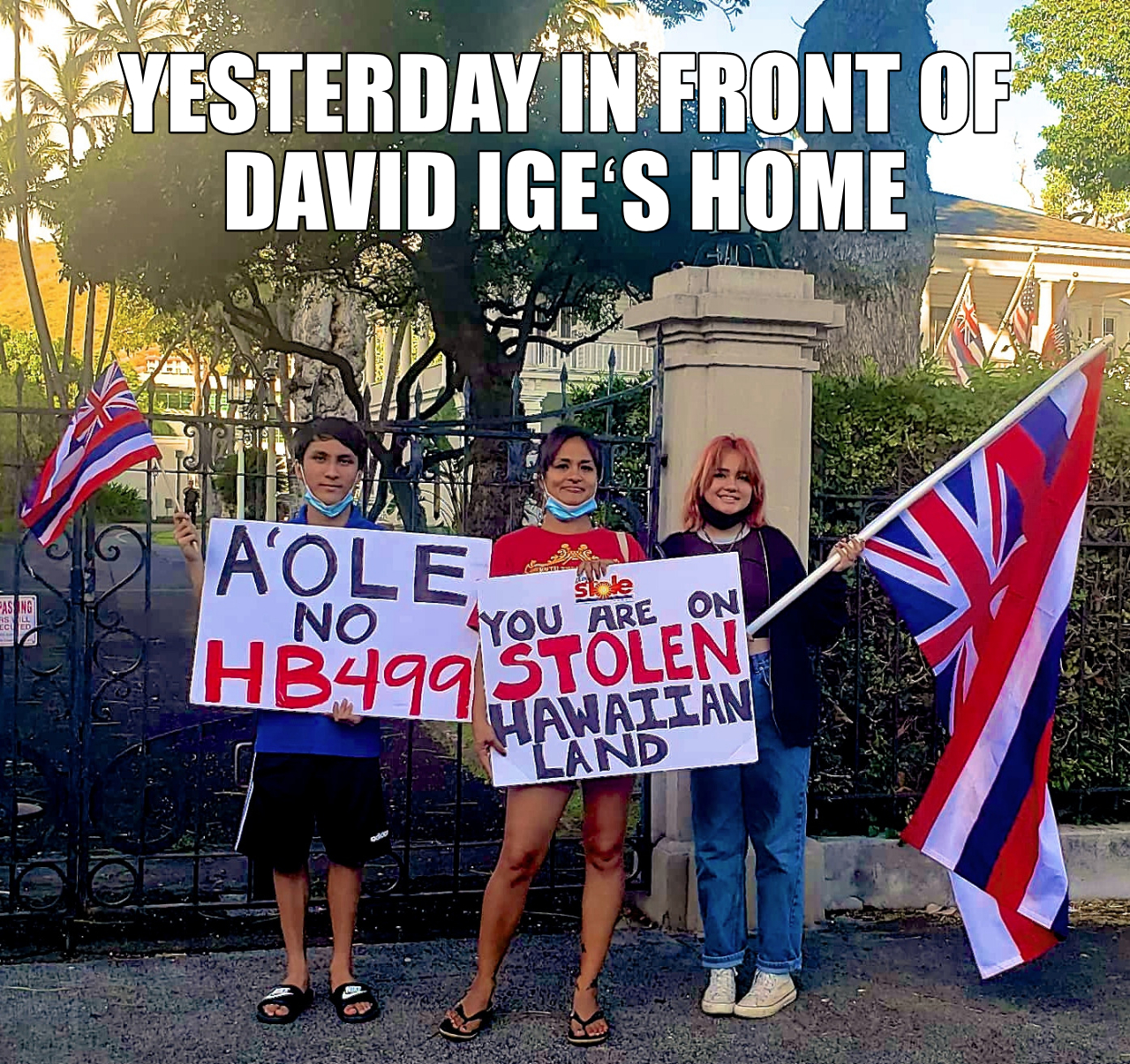
DONʻT LET O`AHU BECOME A GIANT SLUM

Honolulu Civil Beat - June 1, 2021 - By Danny De Gracia
When I was a young boy in the early 1990s, as a military child I had the opportunity to travel outside of the United States into what was then impolitely termed “the Third World” or as we political scientists euphemistically say now, “Least Developed Countries.”
An interesting hallmark of many of these impoverished places is that they often feature opulent resorts where international tourists from wealthy nations can spend their money, and where, if one never left the walls of the compound, it would be easy to assume these countries were clean, aesthetically pleasing and free from all the worries of the world.
Of course, the minute one leaves the resort, it is as if one passes through a portal into a dimension of hellish sorrow, where the road immediately becomes flecked with potholes, the lush grass transitions into naked dirt strewn with trash, the air is putrid with mind-assaulting fecal odors and an oppressive squalor spans the entire countryside.
In such places, tourist zones are havens where everything is well-kept and people are on their best behavior, but the minute you leave, one sees the reality of the country.
Sadly, what was once a characteristic of the Global South is now almost an exact description of life here on Oahu. We have become so mercenary that, in years past, when the Asia-Pacific Economic Conference came to Hawaii, state and city officials were careful to spend millions of dollars to beautify only the major routes that diplomats would travel between the airport and Waikiki or Ko Olina, so as to give the impression that Hawaii was indeed, like the rest of the United States, clean, modern and elegant, unlike the poor countries we wag our fingers at.
Oahu, since the late 2000s, has become neglected, trashy, and dilapidated in many of its public spaces. The COVID-19 pandemic has not helped, and while the stay-at-home orders of last year gave the environment a break, now that both locals and tourists are out and about in our modified Phase III restrictions, Oahu is buckling under the wear-and-tear of people being in public spaces again.
Wednesday, May 12, 2021
FREE HAWAI`I TV
THE FREE HAWAI`I BROADCASTING NETWORK
"HOW THE US STEALS HAWAIIAN LANDS"
Ever Wondered Why Hawaiians Wait Forever On A List To Get Land?
Then They Die Empty Handed After Waiting For Years.
The How & Why This Happens Was Recently Revealed In A Front Page Article.
Watch As We Explain This Bombshell Story & Reveal The Only Real Solution.
Then Share This Video Today With Your Family & Everyone You Know.
Saturday, May 08, 2021
US OCCUPATION - CHEATING HAWAIIANS OUT OF THEIR LAND

Honolulu Star-Advertiser - May 7, 2021
An investigation by the Honolulu Star-Advertiser and ProPublica found that the U.S. government over the past decade has transferred nearly 40 parcels of land in Hawaii to private parties, bypassing a process that normally would give Hawaiians priority access to those lands.
The private deals have a number of things in common: They run directly afoul of the intent of the Hawaiian Home Lands Recovery Act, which was meant to help compensate Hawaiians for lands taken by the federal government in the past. They were made at a time when the need for land has only intensified. They were authorized via special legislation approved by Congress, including members of Hawaii’s own delegation. And some of the acres would have been desirable for homesteads: relatively flat lands where utilities and roads were already in place.
The Navy, which previously had owned the majority of lands involved in the private deals, said it was following the law as expressed by Congress in the special legislation. The General Services Administration, which would have been responsible for offering the land to Native Hawaiians under the recovery act, would not address criticisms about bypassing that law. Current members of Hawaii’s congressional delegation, informed about the findings, said they would work to make sure such deals did not go through in the future.
Here’s where the special legislation authorized most of the private deals:
Area: Nine parcels covering more than 30 acres near Pearl Harbor in Central Oahu.
Features: Mostly flat, connected to utilities and roads. Centrally located in established neighborhoods, minutes from Honolulu’s main airport and freeway. All had existing structures on them that were run by nonprofits, including church organizations. The sites likely would make good candidates for redevelopment into housing.
How the recovery act was bypassed: Three pieces of special legislation introduced into National Defense Authorization Acts in 2009, 2011 and 2013, the first two by Sen. Daniel Inouye.
Congressional support: Sens. Inouye, Daniel Akaka, Mazie Hirono and Brian Schatz, and Reps. Neil Abercrombie, Colleen Hanabusa and Hirono each voted for at least one of the bills.
Who benefited: Eight nonprofits bought their parcels; one more, a private school operator, is waiting for an offer from the Navy.
Interesting fact: The Pearl Harbor chapter of the Fleet Reserve Association, a veterans group, couldn’t afford the $650,000 asking price. So the association got help — a $300,000 state grant — for the 2019 purchase.
Area: Fourteen parcels covering 201 acres in Kalaeloa, a West Oahu Navy base that closed in 199
Features: Mostly abandoned or undeveloped parcels on flat lands in a region where much DHHL development has been done. Roads and utility systems exist but need upgrades.
How the recovery act was bypassed: Provisions in the National Defense Authorization Act for the fiscal years 2000 and 2007.
Congressional support: Sens. Inouye and Akaka, and Reps. Abercrombie, Patsy Mink and Ed Case voted for at least one of the bills.
Who benefited: An affiliate of Hunt Cos., a Texas-based developer, got a contract to develop multiple properties, including Ford Island, a historic Navy base in Pearl Harbor. As part of that deal, Hunt acquired the titles to 14 Navy parcels in Kalaeloa and expects to receive another five, covering more than 280 acres. Hunt is drawing up plans that will allow for up to 3,000 homes on the land. It expects to spend nearly $40 million over the next couple years to upgrade roads and other facilities.
Interesting fact: Hunt intends to sell 30 acres of this land to a local builder, which plans to construct nearly 400 homes. Prices are expected to start in the mid-$500,000s, the builder said, which is beyond the reach of many on the homesteading waitlist.
Areas: About 2 acres split between residential lots on Maui and Hawaii island.
Features: Each of the 11 lots has a home in a residential neighborhood. The residences once housed Coast Guard personnel stationed on the islands.
How the recovery act was bypassed: A provision in the 2010 Coast Guard Authorization Act allowed the Coast Guard to sell property and use the proceeds to acquire and construct military housing. (Nine of the 11 homes were ultimately sold under that provision.)
Congressional support: Hirono voted for the bill. The Senate passed the measure by unanimous consent.
Who benefited: Individual buyers and a Maui housing nonprofit acquired the properties in 2011 and 2018.
Interesting fact: One buyer paid $225,000 for a Hilo home on the Big Island and sold it five months later for $325,000 in 2019.
Friday, May 07, 2021
HAS THE ILLEGAL US OCCUPATION OF HAWAI`I WORKED?

Honolulu Star-Advertiser - May 7, 2021
In the 1990s, Hawaii’s two elder statesmen — U.S. Sens. Daniel Inouye and Daniel Akaka — were at the forefront of efforts to ensure that the U.S. compensated Native Hawaiians for ancestral lands taken from them over the years.
“Dan Inouye believed that a promise made should be a promise kept,” Akaka, a Native Hawaiian, said in 2012 upon the death of his longtime Senate colleague.
But an investigation by the Honolulu Star-Advertiser and ProPublica has found that those same senators voted several times each to support must-pass legislation that included provisions undermining efforts to repay millions of dollars in land debt to Hawaiians. At least six other current and former members of Hawaii’s congressional delegation have supported such legislation one or more times.
Between them, Hawaii’s members of Congress voted for at least six laws authorizing the federal government to sell dozens of excess properties to private parties rather than offering them to a Hawaiian trust established to repatriate the land. In one must-pass military spending bill spanning more than 500 pages, lawmakers slipped in a single sentence that helped a handful of nonprofits to acquire the land. In another, they added language that effectively put the need for military housing ahead of the need for housing Hawaiians.
The circumvention of the landmark 1995 Hawaiian Home Lands Recovery Act, which has not been previously reported, sent the excess lands to a variety of buyers instead: the Catholic Church; the nonprofit operator of a private school; a developer that intends to sell a site to another company with plans to construct hundreds of private-sector homes there....
Wednesday, January 13, 2021
FREE HAWAI`I TV
THE FREE HAWAI`I BROADCASTING NETWORK
"INSURRECTION IN OUR NATIONʻS CAPITOL"
THE FREE HAWAI`I BROADCASTING NETWORK
"INSURRECTION IN OUR NATIONʻS CAPITOL"
It Was A Shocking & Unbelievable Sight.
Armed Insurgents At Our Governmentʻs Seat Of Power.
But Weʻre Not Referring To The US Capitol In Washington, DC.
Watch This To See Where We Mean & Also The Amazing Parallels.
Armed Insurgents At Our Governmentʻs Seat Of Power.
But Weʻre Not Referring To The US Capitol In Washington, DC.
Watch This To See Where We Mean & Also The Amazing Parallels.
Wednesday, November 04, 2020
FREE HAWAI`I TV
THE FREE HAWAI`I BROADCASTING NETWORK
"ARE YOU WE OR ME?"
THE FREE HAWAI`I BROADCASTING NETWORK
"ARE YOU WE OR ME?"
Is All Youʻve Been Hearing Lately Is People Demanding Their Rights?
Where In The World Does That Come From?
Can Hawai`i Teach A Better Way To Express This?
Watch Our Report For The Answer About A Very Different Way To Live.
Where In The World Does That Come From?
Can Hawai`i Teach A Better Way To Express This?
Watch Our Report For The Answer About A Very Different Way To Live.

Subscribe to:
Posts (Atom)





