skip to main |
skip to sidebar
SMITHSONIAN SHINES LIGHT ON HAWAIIAN KINGDOM QUEENS
Colorlines.com - March 18, 2019
The Smithsonian Asian Pacific American Center’s Learning Together program announced in an emailed statement last week that, as part of Women’s History Month, it will share teaching materials on two women who were critical to the history of the Hawaiian Kingdom.
The Center’s Learning Lab, an online resource for educators, includes a wide range of content focusing on Queen Kapi‘olani (1834-1899) and Queen Liliʻuokalani (1838-1917)—two of the most important leaders in a rich native culture that existed long before the establishment of the United States.
The archival objects include a personal, recreational wa‘a (vah-ah), or canoe, that Queen Kapi‘olani gave the Smithsonian as a gift of goodwill from the Hawaiian Kingdom to the United States. The Learning Together website also features a short video that explores some of the secrets of the canoe—which at 231 years old is the oldest known Hawaiian canoe in any museum, anywhere in the world.
Those who visit the site will learn that almost 200 years* before Hawai‘i became the 50th state, women played a powerful role in the kingdom’s rich culture. For example, Queen Kapi‘olani was an influential philanthropist who advocated for the health of women in Hawai‘i. She became an ambassador of the Kingdom, traveling across the Pacific Ocean and the United States for the first White House state dinner in 1874. She also established the Kapi‘olani Maternity Home on the island of O‘ahu, where mothers could receive support and care for themselves and their children.
Queen Liliʻuokalani was the last queen regent of the Hawaiian Kingdom before the government was overthrown by the United States in 1893. Her love for her country and citizens led her to fight for their equal rights, land and restoration of the Kingdom many years after the Hawaiian government was overthrown. A gifted writer, composer and musician, she created many popular works, including the famous song “Aloha Oe,” which she wrote while under house arrest for her attempts to reinstate the Hawaiian Kingdom.
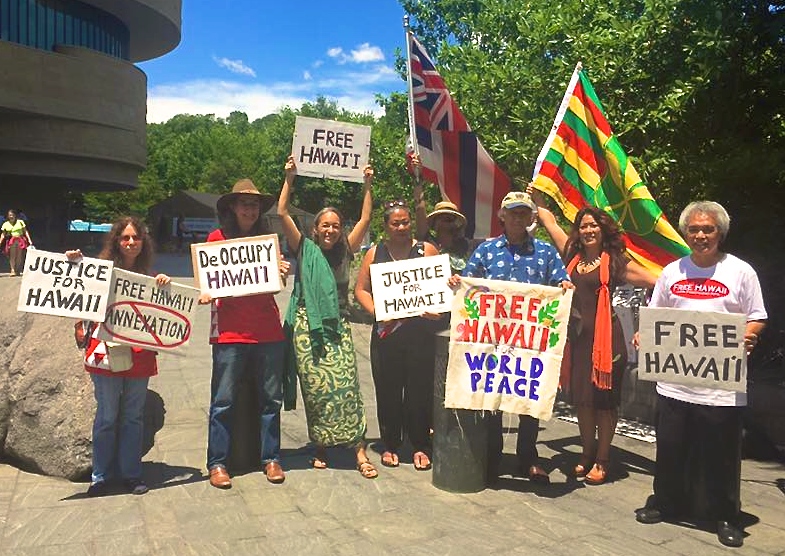
YESTERDAYʻS RED RIBBONS CEREMONY AT THE SMITHSONIAN IN WASHINGTON, DC
SMITHSONIAN.COM - HAWAIIANS NOT OPPOSED TO SCIENCE & TECHNOLOGY
Smithsonian.com - April 23, 2015 - By Doug Herman
At this moment all over the Hawaiian islands, but especially atop Mauna Kea volcano, there are protests against the building of a new Thirty-Meter Telescope (TMT) on this sacred mountain. The telescope has become a cause célèbre among Native Hawaiians and their allies, and the issue is going viral. Newspapers around the world are reporting the story and people are abuzz on social media—especially as the issue becomes more emotionally charged. This week, a University of California, Berkeley professor sent around a petition in favor of the telescope with language in it that has incited charges of racism. A group of scientists countered with a statement saying the message was unacceptable.
From the outside, this argument may seem like another case of Native beliefs versus modern science. As astronomer Tom Kerr wrote back in 2011, "It seems to me that it's an argument about returning to the stone age versus understanding our universe and it'll be interesting to see who wins in the end."
Mauna Kea is the highest peak in the Hawaiian islands. This massive dormant volcano rises 13,796 feet (4,205 m) above sea level and in the winter its top is often blanketed in snow. “Mauna kea” means “white mountain,” but there are those who say it is short for “Mauna o Wakea,” the mountain of the Hawaiian deity Wākea. Either way, its summit is considered to be a most sacred—if not the most sacred—spot in the Hawaiian archipelago. Its rugged peak, covered in small cinder cones or puʻu, is the home to a handful of Hawaiian deities.
But because the Hawaiian Islands lie far out in the middle of the Pacific, far from any continental landmass, and because the atmosphere is much cleaner and there is far less “light pollution” from urban areas, this makes Mauna Kea one of the best places on the planet for astronomical observatories. So it is also home to the world's largest, with 13 working telescopes operated by astronomers from 11 different countries. (The Harvard Smithsonian Center for Astrophysics operates the Submillimeter Array (SMA) on Mauna Kea, but is involved in the construction of the Giant Magellan Telescope in Chile's Atacama desert rather than this one on Mauna Kea.) The new TMT would enable astronomers to see “forming galaxies at the very edge of the observable Universe, near the beginning of time.”
And this is where the problem lies.
Astronomy on Mauna Kea has been a boon to the University of Hawaii and brought income to the State. The nearby town of Hilo takes pains to honor its neighbor and has low-intensity street lights to keep ambient light to a minimum.
But protests against construction on Mauna Kea have been going on for decades. The existing white observatory buildings are readily seen (on clear days) from many parts of the island. And while the current project has engaged in a lengthy public review process, including consultations with Native Hawaiian groups, the history has been far less sensitive to Native opinion.
What is really at stake, however, is a conflict between two ways of knowing and being in the world. For many Native Hawaiians and other Indigenous peoples, sacredness is not merely a concept or label. It is a lived experience of oneness and connectedness with the natural and spiritual worlds. It is as common sense as believing in gravity. This experience is very much at odds with the everyday secular-humanist approach of Western thinking that emerged out of the Enlightenment (as I have discussed in a previous essay), and which sees no “magic” or “enchantment” in the world. And of course, seeing nature as inert facilitates both commercial exploitation and scientific exploration.