Showing posts with label Hawaiian Independence. Show all posts

Tuesday, July 04, 2023

WILL YOU BE LIKE THEM?


Monday, November 28, 2022

HAU`OLI LĀ KU`OKO`A


Saturday, November 26, 2022

WOW - DONʻT MISS THIS TOMORROW


Monday, July 25, 2022

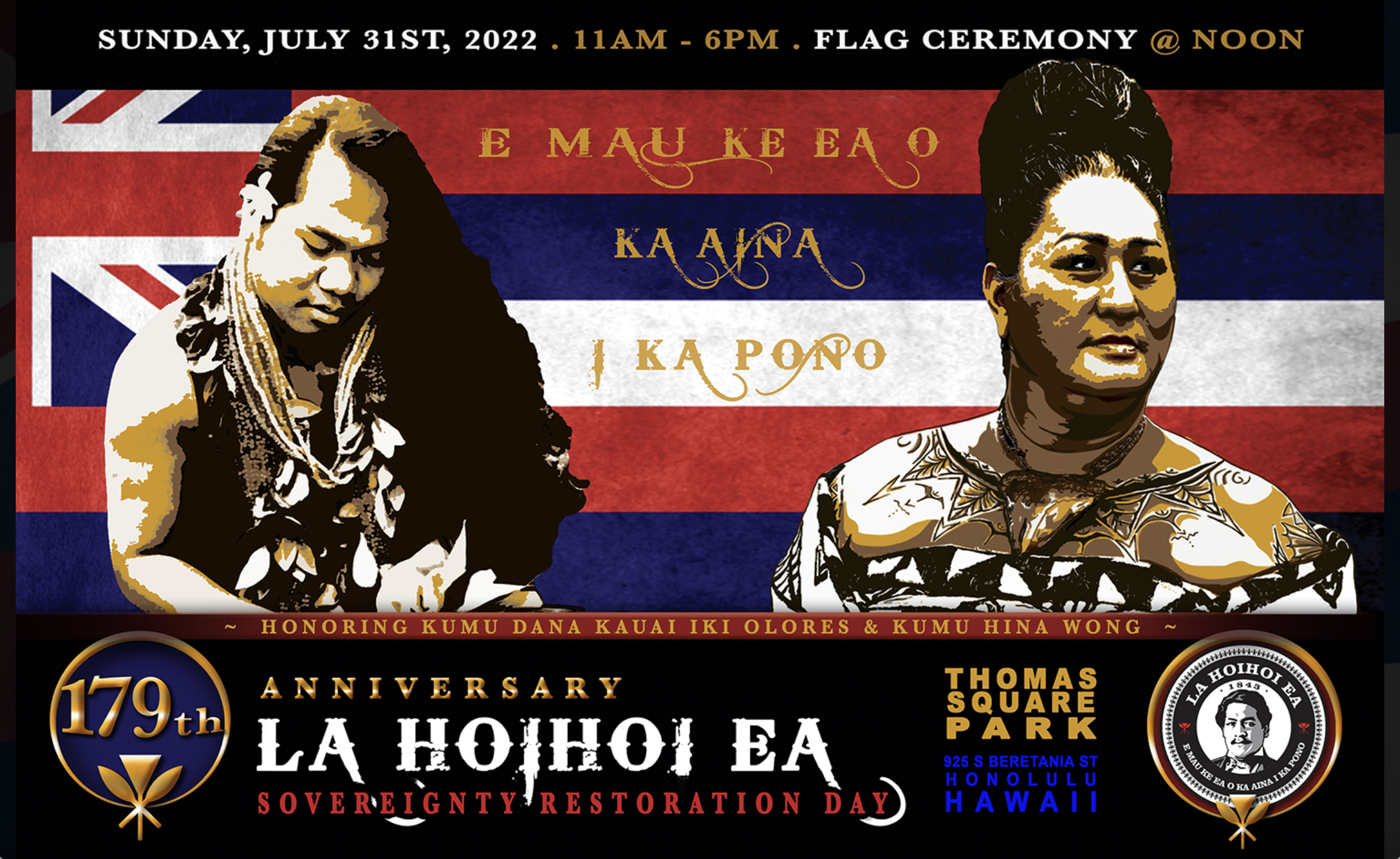
DONʻT MISS IT THIS COMING SUNDAY AT THOMAS SQUARE IN HONOLULU


Friday, November 26, 2021

DONʻT MISS IT - BE THERE THIS SUNDAY


Saturday, November 20, 2021

DONʻT MISS IT ONE WEEK FROM TOMORROW


Saturday, November 28, 2020

WHAT IS LA KU`OKO`A - INDEPENDENCE DAY IN HAWAI`I?


In the Hawaiian Kingdom, November 28 was an official holiday called Lā Kū`oko`a, or Independence Day. This was the day in 1843 when England and France formally recognized Hawai`i's independence.

Faced with the problem of foreign encroachment of Hawaiian territory, His Majesty King Kamehameha III deemed it prudent and necessary to dispatch a Hawaiian delegation to the United States and then to Europe, with the power to negotiate treaties and to ultimately secure the recognition of Hawaiian Independence by the major powers of the world.

In accordance with this view, Timoteo Ha`alilio, William Richards and Sir George Simpson were commissioned as joint Ministers Plenipotentiary on April 8, 1842.

Sir George Simpson, shortly thereafter, left for England, via Alaska and Siberia, while Mr. Ha`alilio and Mr. Richards departed for the United States, via Mexico and the US on July 8, 1842.


The Hawaiian delegation, while in the United States of America, secured the assurance of US President Tyler on December 19, 1842 of its recognition of Hawaiian independence, and then proceeded to meet Sir George Simpson in Europe and secure formal recognition by Great Britain and France.

On March 17, 1843, King Louis-Phillipe of France recognized Hawaiian independence at the urging of King Leopold of Belgium, and on April 1, 1843, Lord Aberdeen on behalf of Her Britannic Majesty Queen Victoria, assured the Hawaiian delegation that:


"Her Majesty's Government was willing and had determined to recognize the independence of the Sandwich Islands under their present sovereign."

Formal Agreement of Recognition -

 
On November 28, 1843, at the Court of London, the British and French Governments entered into a formal agreement of the recognition of Hawaiian independence, with what is called the Anglo-Franco Proclamation.

To wit-


"Her Majesty the Queen of the United Kingdom of Great Britain and Ireland, and His Majesty the King of the French, taking into consideration the existence in the Sandwich Islands (Hawaiian Islands) of a government capable of providing for the regularity of its relations with foreign nations, have thought it right to engage, reciprocally, to consider the Sandwich Islands as an Independent State, and never to take possession, neither directly or under the title of Protectorate, or under any other form, of any part of the territory of which they are composed.

The undersigned, Her Majesty's Principal Secretary of State of Foreign Affairs, and the Ambassador Extraordinary of His Majesty the King of the French, at the Court of London, being furnished with the necessary powers, hereby declare, in consequence, that their said Majesties take reciprocally that engagement.

In witness whereof the undersigned have signed the present declaration, and have affixed thereto the seal of their arms.

Done in duplicate at London, the 28th day of November, in the year of our Lord, 1843.
[L.S.] Aberdeen [L.S.] St. Aulaire" 


National Holiday -
November 28 was thereafter established as an official national holiday of the Hawaiian Kingdom to celebrate Hawaii's independence.


International Stature -
As a result of this recognition, the Hawaiian Kingdom entered into treaties with the major nations of the world and established over ninety diplomatic legations and consulates in seaports and cities around the world.

The Fake Revolution -
Fifty years later, in 1893, an illegal intervention by the U.S. military resulted in a "fake revolution" against the legitimate Hawaiian government, and a puppet oligarchy set itself up with its main purpose of annexing Hawai`i to the United States.

After a failed armed attempt by Hawaiians to retake their Kingdom in 1895, the usurpers announced that Lā Kū`oko`a would no longer be celebrated, and the American holiday Thanksgiving Day would be the official national holiday instead.

Removing a holiday like Hawai`i Independence Day was a way to cover up and try to destroy the history and identity of the Hawaiian Kingdom and its people. 


At first Hawaiians protested and celebrated Lā Kū`oko`a anyway, telling the story of the national heroes who had traveled to Europe to secure Hawaii's recognition.

But over time, this history — knowledge of the holiday and how it was replaced — faded and was almost lost, until recently, when Hawaiian language scholars started translating Hawaiian language newspapers and rediscovered the story.


The celebration of Lā Kū`oko`a asserts that Hawai`i is still an independent nation, even under prolonged illegal occupation.

Saturday, August 01, 2020

KOANI FOUNDATION PRESENTS EIGHTH ANNUAL HAWAIIAN KINGDOM PATRIOT AWARDS AT LA HOI`HO`I EA 

Andre Perez & Michael Lee Honored


Koani Foundation Director Leon Siu Presents The Awards To Andre Perez (Top) & Peter Lee (Bottom) On Behalf Of The Late Michael Lee


The Koani Foundation awarded its eighth annual Hawaiian Kingdom Patriot Awards honoring two Hawaiian Kingdom patriots yesterday Friday, July 31st at Thomas Square in Honolulu.

The awards presentation took place at 10:00 AM in front of the statue of Kamehameha III at Thomas Square as part of a daylong observance of La Ho`iho`i Ea, Hawaiian Sovereignty Restoration Day.

Andre Perez and the late Michael Kumukauoha Lee are the 2020 honorees.

Mauna Kea kia`i or protector Andre Perez was honored in recognition for his critical leadership in protecting Mauna Kea from the construction of the Thirty Meter Telescope. Andre was given the Living Patriot Award.

The late kumu and kahu Michael Kumukahuola Lee was honored with the posthumous award for his work in protecting Hawaiian sacred places such as Kaho`olawe and burial sites; the environment from the mountains to the sea.

“Andreʻs leadership, along with others, was key in protecting Mauna Kea, the most sacred `aina or land in all of Hawai`i and stopping the Thirty Meter Telescope from being built and desecrating the Mauna,” stated Koani Foundation director Leon Siu.

“Michaelʻs life work was protecting ancient Hawaiian burial grounds as well as Hawai`iʻs precious limu (seaweed) and our pueo (Hawaiian owl) which hold such significance for our culture.”

“We owe both Andre and Michael our profound mahalo for their passion and lifetime dedication and both are examples of what it means to live oneʻs life as Hawaiian Kingdom patriots,” added Siu.

For more information, visit KoaniFoundation.org

Friday, July 31, 2020

EIGHTH ANNUAL HAWAIIAN KINGDOM PATRIOT AWARDS ANNOUNCED


Koani Foundation Recognize Patriots Andre Perez & Michael Lee

The Koani Foundation has announced its eighth annual Hawaiian Kingdom Patriot Awards honoring two Hawaiian Kingdom patriots today Friday, July 31st at Thomas Square in Honolulu.

The awards presentation took place at 10:00 AM in front of the statue of Kamehameha III at Thomas Square as part of a daylong observance of La Ho`iho`i Ea, Hawaiian Sovereignty Restoration Day.

Andre Perez and the late Michael Kumukauoha Lee are the 2020 honorees.

Mauna Kea kia`i or protector Andre Perez is being honored in recognition for his critical leadership in protecting Mauna Kea from the construction of the Thirty Meter Telescope. Andre is being given the Living Patriot Award.

The late kumu and kahu Michael Kumukahuola Lee is being honored with the posthumous award for his work in protecting Hawaiian sacred places such as Kaho`olawe and burial sites; the environment from the mountains to the sea.

“Andreʻs leadership, along with others, was key in protecting Mauna Kea, the most sacred `aina or land in all of Hawai`i and stopping the Thirty Meter Telescope from being built and desecrating the Mauna,” states Koani Foundation director Leon Siu.

“Michaelʻs life work was protecting ancient Hawaiian burial grounds as well as Hawai`iʻs precious limu (seaweed) and our pueo (Hawaiian owl) which hold such significance for our culture.”

“We owe both Andre and Michael our profound mahalo for their passion and lifetime dedication and both are examples of what it means to live oneʻs life as Hawaiian Kingdom patriots,” added Siu.

Hawaiian Sovereignty Restoration Day marks July 31,1843 when British Admiral Richard Thomas ordered the Union Jack lowered and the Hawaiian Kingdom flag hoisted above Honolulu, ending five months of British occupation and restoring the sovereignty of the Hawaiian Kingdom government to legitimate power.

For more information, visit KoaniFoundation.org

Wednesday, November 28, 2018

FREE HAWAI`I TV
THE FREE HAWAI`I BROADCASTING NETWORK


"WHOʻS CELEBRATING INDEPENDENCE IN HAWAI`I?"

Today is La Ku`oko`a, Independence Day In Hawai`i.

On This Date In 1843, Two Big Countries Recognized The Hawaiian Kingdom.

But Can We Celebrate Hawai`iʻs Independence Today While Under A US Occupation?

Watch This To See Whoʻs Doing It & How, So Theyʻll Be Free In Hawai`i.


Then Share This Video Today With Your Family & Everyone You Know.

Tuesday, November 27, 2018

WHAT IS LA KU`OKO`A - INDEPENDENCE DAY IN HAWAI`I?


In the Hawaiian Kingdom, November 28 was an official holiday called Lā Kū`oko`a, or Independence Day. This was the day in 1843 when England and France formally recognized Hawai`i's independence.

Faced with the problem of foreign encroachment of Hawaiian territory, His Majesty King Kamehameha III deemed it prudent and necessary to dispatch a Hawaiian delegation to the United States and then to Europe, with the power to negotiate treaties and to ultimately secure the recognition of Hawaiian Independence by the major powers of the world.

In accordance with this view, Timoteo Ha`alilio, William Richards and Sir George Simpson were commissioned as joint Ministers Plenipotentiary on April 8, 1842.

Sir George Simpson, shortly thereafter, left for England, via Alaska and Siberia, while Mr. Ha`alilio and Mr. Richards departed for the United States, via Mexico and the US on July 8, 1842.


The Hawaiian delegation, while in the United States of America, secured the assurance of US President Tyler on December 19, 1842 of its recognition of Hawaiian independence, and then proceeded to meet Sir George Simpson in Europe and secure formal recognition by Great Britain and France.

On March 17, 1843, King Louis-Phillipe of France recognized Hawaiian independence at the urging of King Leopold of Belgium, and on April 1, 1843, Lord Aberdeen on behalf of Her Britannic Majesty Queen Victoria, assured the Hawaiian delegation that:


"Her Majesty's Government was willing and had determined to recognize the independence of the Sandwich Islands under their present sovereign."

Formal Agreement of Recognition -

 
On November 28, 1843, at the Court of London, the British and French Governments entered into a formal agreement of the recognition of Hawaiian independence, with what is called the Anglo-Franco Proclamation.

To wit-


"Her Majesty the Queen of the United Kingdom of Great Britain and Ireland, and His Majesty the King of the French, taking into consideration the existence in the Sandwich Islands (Hawaiian Islands) of a government capable of providing for the regularity of its relations with foreign nations, have thought it right to engage, reciprocally, to consider the Sandwich Islands as an Independent State, and never to take possession, neither directly or under the title of Protectorate, or under any other form, of any part of the territory of which they are composed.

The undersigned, Her Majesty's Principal Secretary of State of Foreign Affairs, and the Ambassador Extraordinary of His Majesty the King of the French, at the Court of London, being furnished with the necessary powers, hereby declare, in consequence, that their said Majesties take reciprocally that engagement.

In witness whereof the undersigned have signed the present declaration, and have affixed thereto the seal of their arms.

Done in duplicate at London, the 28th day of November, in the year of our Lord, 1843.
[L.S.] Aberdeen [L.S.] St. Aulaire" 


National Holiday -
November 28 was thereafter established as an official national holiday of the Hawaiian Kingdom to celebrate Hawaii's independence.


International Stature -
As a result of this recognition, the Hawaiian Kingdom entered into treaties with the major nations of the world and established over ninety diplomatic legations and consulates in seaports and cities around the world.

The Fake Revolution -
Fifty years later, in 1893, an illegal intervention by the U.S. military resulted in a "fake revolution" against the legitimate Hawaiian government, and a puppet oligarchy set itself up with its main purpose of annexing Hawai`i to the United States.

After a failed armed attempt by Hawaiians to retake their Kingdom in 1895, the usurpers announced that Lā Kū`oko`a would no longer be celebrated, and the American holiday Thanksgiving Day would be the official national holiday instead.

Removing a holiday like Hawai`i Independence Day was a way to cover up and try to destroy the history and identity of the Hawaiian Kingdom and its people. 


At first Hawaiians protested and celebrated Lā Kū`oko`a anyway, telling the story of the national heroes who had traveled to Europe to secure Hawaii's recognition.

But over time, this history — knowledge of the holiday and how it was replaced — faded and was almost lost, until recently, when Hawaiian language scholars started translating Hawaiian language newspapers and rediscovered the story.


Tomorrowʻs celebration of Lā Kū`oko`a asserts that Hawai`i is still an independent nation, even under prolonged illegal occupation.

Monday, December 25, 2017

Tuesday, November 28, 2017

WHAT IS LA KU`OKO`A - INDEPENDENCE DAY IN HAWAI`I?


In the Kingdom of Hawai`i, November 28 was an official holiday called Lā Kū`oko`a, or Independence Day. This was the day in 1843 when England and France formally recognized Hawai`i's independence.

Faced with the problem of foreign encroachment of Hawaiian territory, His Majesty King Kamehameha III deemed it prudent and necessary to dispatch a Hawaiian delegation to the United States and then to Europe, with the power to negotiate treaties and to ultimately secure the recognition of Hawaiian Independence by the major powers of the world.

In accordance with this view, Timoteo Ha`alilio, William Richards and Sir George Simpson were commissioned as joint Ministers Plenipotentiary on April 8, 1842.

Sir George Simpson, shortly thereafter, left for England, via Alaska and Siberia, while Mr. Ha`alilio and Mr. Richards departed for the United States, via Mexico and the US on July 8, 1842.


The Hawaiian delegation, while in the United States of America, secured the assurance of US President Tyler on December 19, 1842 of its recognition of Hawaiian independence, and then proceeded to meet Sir George Simpson in Europe and secure formal recognition by Great Britain and France.

On March 17, 1843, King Louis-Phillipe of France recognized Hawaiian independence at the urging of King Leopold of Belgium, and on April 1, 1843, Lord Aberdeen on behalf of Her Britannic Majesty Queen Victoria, assured the Hawaiian delegation that:


"Her Majesty's Government was willing and had determined to recognize the independence of the Sandwich Islands under their present sovereign."

Formal Agreement of Recognition -

 
On November 28, 1843, at the Court of London, the British and French Governments entered into a formal agreement of the recognition of Hawaiian independence, with what is called the Anglo-Franco Proclamation.

To wit-


"Her Majesty the Queen of the United Kingdom of Great Britain and Ireland, and His Majesty the King of the French, taking into consideration the existence in the Sandwich Islands (Hawaiian Islands) of a government capable of providing for the regularity of its relations with foreign nations, have thought it right to engage, reciprocally, to consider the Sandwich Islands as an Independent State, and never to take possession, neither directly or under the title of Protectorate, or under any other form, of any part of the territory of which they are composed.

The undersigned, Her Majesty's Principal Secretary of State of Foreign Affairs, and the Ambassador Extraordinary of His Majesty the King of the French, at the Court of London, being furnished with the necessary powers, hereby declare, in consequence, that their said Majesties take reciprocally that engagement.

In witness whereof the undersigned have signed the present declaration, and have affixed thereto the seal of their arms.

Done in duplicate at London, the 28th day of November, in the year of our Lord, 1843.
[L.S.] Aberdeen [L.S.] St. Aulaire" 


National Holiday -
November 28 was thereafter established as an official national holiday of the Hawaiian Kingdom to celebrate Hawaii's independence.


International Stature -
As a result of this recognition, the Hawaiian Kingdom entered into treaties with the major nations of the world and established over ninety diplomatic legations and consulates in seaports and cities around the world.

The Fake Revolution -
Fifty years later, in 1893, an illegal intervention by the U.S. military resulted in a "fake revolution" against the legitimate Hawaiian government, and a puppet oligarchy set itself up with its main purpose of annexing Hawai`i to the United States.

After a failed armed attempt by Hawaiians to retake their Kingdom in 1895, the usurpers announced that Lā Kū`oko`a would no longer be celebrated, and the American holiday Thanksgiving Day would be the official national holiday instead.

Removing a holiday like Hawai`i Independence Day was a way to cover up and try to destroy the history and identity of the Hawaiian Kingdom and its people. 


At first Hawaiians protested and celebrated Lā Kū`oko`a anyway, telling the story of the national heroes who had traveled to Europe to secure Hawaii's recognition.

But over time, this history — knowledge of the holiday and how it was replaced — faded and was almost lost, until recently, when Hawaiian language scholars started translating Hawaiian language newspapers and rediscovered the story.


Today’s celebration of Lā Kū`oko`a asserts that Hawai`i is still an independent nation, even under prolonged illegal occupation.

Tuesday, March 31, 2015

WHAT CAN AMERICANS DO TO HELP FREE HAWAI`I?

US Americans should start using critical thinking in resolving the Hawai`i fake state issue.

If in fact the US is unlawfully occupying Hawai`i logically it should deoccupy it.

US Americans should become familiar with the laws of occupation to understand the issues.

They will then also understand the folly of the failed attempt to turn Hawaiians into American indians and tribes through Kana`iolowalu, the Native Hawaiian roll and what it seditiously represented.

Itʻs well past time for US citizens to learn of the outright lies and misrepresentations of facts that have been fostered on US Americans and what has and is being done in their name.

Amid myths and hoax lie documented facts with US admittance of complicity through covert and overt activities to destabilize the Hawaiian Kingdom. 

US actions include outright invasion and takeover through a declaration among those involved, with the covert assistance of the US which was unbeknownst to the citizens of the Kingdom over a century ago.

This all took shape in insurgents staging a fake revolution to validate the villainous actions spurred by US government officials and their American agents and counterparts residing within the Hawaiian Kingdom.


Saturday, March 28, 2015

CURIOUS ABOUT HOW HAWAI`I SUPPOSEDLY BECAME A US STATE ?

The United States acquired Hawai`i through force.

Queen Lili'uokalani, Hawai`i's last Queen, was deposed on Jan. 17, 1893, by a group of American businessmen supported by the United States Navy and Marine Corps and diplomatic representatives.

Sovereignty of Hawai`i was allegedly transferred to the US on Aug. 12, 1898 during ceremonies at `Iolani Palace in Honolulu, on the island of O`ahu.

Hawai`i allegedly became a US territory in 1900.

On Nov. 23, 1993, the United States apologized for illegally overthrowing the Kingdom of Hawai`i, and recognized the inherent sovereignty and right of self-determination of native islanders.

Needless to say, a lot of shady events took place between January 17,1893 and August 21, 1959.

Today, the US and itʻs puppet, the fake state of Hawai`i, is attempting to cover over itʻs illegal and immoral acts by offering to make native Hawaiians American Indians and place them on reservations.

Needless to say Hawaiian sovereignty is a hot issue in the islands to this day and likely will be for as long as the United States illegal occupation of Hawai`i continues.

Hawaiian Kingdom Nationals Were Told They Were Adopted - But Instead Found Out They'd Been Kidnapped.


Tuesday, January 20, 2015

CASH THAT MAKES A SPLASH!

Friday, January 09, 2015

IS IT ANY WONDER PEOPLE WANT THE ILLEGAL OCCUPATION OF HAWAI`I TO END?

Life Harder Under US Occupation


The Hawaiian Kingdom grew all its own food and was even a food exporter to California during the Gold Rush days.

Today the fake state of Hawai`i imports 95% of all its food from the US.

In the 1980s, Hawai`i gained the enviable reputation of providing medical insurance to the highest percentage of residents of any state.

But after the state ended dental cover, toothless smiles are commonplace among the poor. Tens of thousands of residents have no medical insurance at all.
 

Despite higher profits for many businesses, jobs are scarce and most of the available work pays minimum wage or close to it.

In some cases, the lives of the working poor are worse than the unemployed.
Among other things, they don't qualify for state financial assistance or full food stamp benefits.
 
Today most of Hawai`i island, Molokai, Lana`i and Kaua`i are economic wastelands with little opportunity to make a decent living.

Workers often share apartments or small houses with several other workers because rents are too expensive for one or two individuals to afford.
 
On every island married couples with children often work two or even three jobs just to make ends meet - if they are fortunate enough to find that many jobs, even at minimum wage.


Tuesday, January 06, 2015

"A DELIBERATE ATTEMPT TO DO UNLAWFULLY THAT WHICH CANNOT BE LAWFULLY DONE" 

Honolulu Advertiser - March 12, 2000


US DEPT OF JUSTICE LEGAL OPINION - October 4, 1988

"It Is Therefore Unclear Which Constitutional Power Congress Exercised When It Acquired Hawai`i By Joint Resolution. Accordingly, It Is Doubtful That The Acquisition Of Hawai`i Can Serve As An Appropriate Precedent For A Congressional Assertion Of Sovereignty..."

Monday, December 29, 2014

HERE'S WHAT HAWAI`I NATIONALS SAID WHEN THE US OVERTHREW & STOLE THE HAWAIIAN KINGDOM IN 1893


"We protest against the movement in favor of doing away with the independence of our country; we protest against the effort to force annexation to the US without consulting the people...."

- Hui Aloha `Aina (Hawaiian Patriotic League) 


Hereʻs What We Could Say Today -

"We protest against the movement in favor of doing away with the independence of our country; we protest against the effort to force Kana`iolowalu, the Native Hawaiian roll upon us without consulting the people...."

Saturday, December 27, 2014

WILL EVERYONE HAVE TO BE UNITED BEFORE GAINING A FREE HAWAI`I?

While unity sounds nice, it is not necessary or realistic to reclaim a nation.


After all, how unified is the United States?

In America’s two-party system, aren’t those two parties diametrically opposed over nearly every issue?

We need look no further than the current budget crisis in Washington, DC for the answer.

And what about the subdivisions of the many factions? Democrats, Republicans, Libertarians, Conservative Democrats, Liberal Democrats, Conservative Republicans, Liberal Republicans, Independents, Socialists, etc.

If unification is the ideal criteria, shouldn’t all these American factions be in unity or in agreement before the US makes any important decision or takes any action or conducts its operations?

Have you ever watched the US congress or the British parliament in session? Do they exemplify unity?
If you really think about it, democracy is the opposite of unity, while only dictatorships demand unity.

So why should Hawai`i have to conform to a standard that no other nation, not even the US, is required to uphold?
 

A Free Hawai`i is the unifying cause. 

The various factions are already united in what matters most — a burning desire to see Hawai`i restored as an independent, sovereign nation.